
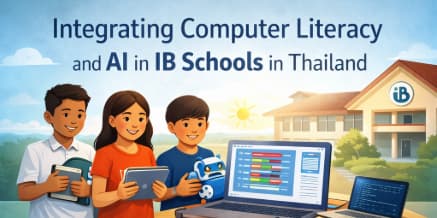
As technology continues to shape education and future careers, many International Baccalaureate schools in Thailand are giving students earlier and stronger exposure to computer literacy and artificial intelligence. Rather than treating technology as a separate subject only for older students, these schools often build digital skills across all stages of learning, from the Primary Years Programme through to the Diploma Programme.
This approach helps students develop more than just technical ability. They learn how to solve problems, think logically, work with data, and use technology responsibly. In the context of Thailand’s growing digital economy, this also supports wider national goals around innovation, digital readiness, and future-focused education.
At a Glance: How Technology Is Built Across the IB Journey
| IB Programme | Age Range | Main Tech Focus | Typical Learning Outcomes |
| Primary Years Programme PYP | 3–12 | Basic computer literacy, coding logic, digital citizenship | Understand sequences, use simple coding tools, develop comfort with technology |
| Middle Years Programme MYP | 11–16 | Programming, data handling, AI concepts, ethical discussions | Build apps, explore machine learning, apply tech to real-life issues |
| Diploma Programme DP | 16–19 | Advanced computing, AI applications, research, real-world projects | Create more complex systems, explore AI in depth, prepare for university |
Technology in the Primary Years Programme
In the Primary Years Programme, technology is usually introduced in a practical and age-appropriate way. Instead of beginning with complex programming, younger children are guided through foundational concepts such as sequencing, logic, and basic problem-solving. These skills are often taught through hands-on activities, games, and visual coding platforms.
Teachers may use block-based tools like ScratchJr or beginner coding activities to help students understand how instructions work. Children can create simple animations, interactive stories, or classroom-based projects that connect computing with other subjects. At this level, technology is often linked to broader inquiry themes, helping students see how digital tools connect with the world around them.

Common PYP Technology Activities
| Activity | What Students Learn | Why It Matters |
| Block-based coding | Sequencing, logic, simple commands | Builds confidence with structured thinking |
| Keyboard and device use | Basic digital fluency | Prepares students for later academic work |
| Classroom data activities | Simple charts and visual data | Introduces information handling |
| Robot navigation tasks | Spatial awareness and problem-solving | Makes coding tangible and engaging |
| Digital citizenship lessons | Privacy, behavior, online responsibility | Builds healthy early habits |
Another important part of early computer literacy is helping students understand that technology should be used thoughtfully. Even at a young age, students can begin discussing topics such as screen use, personal information, and how smart devices are part of daily life. In Thailand, many IB schools also support this learning with bilingual explanations, helping students access new concepts in both English and Thai when needed.
Hands-On Coding in Primary Classrooms
One of the most effective ways to teach younger learners is through projects. Coding in primary classrooms often works best when students create something meaningful rather than simply memorizing commands. For example, they may build a digital story inspired by Thai festivals, create a simple game, or guide a classroom robot through a maze.
These activities support more than digital skills alone. They also develop collaboration, resilience, and creativity. Students learn that mistakes are part of the process, especially when debugging and improving their work. This kind of project-based learning fits naturally with the IB approach, which values curiosity, reflection, and active exploration.

Advancing Computer Literacy and AI in the Middle Years Programme
As students move into the Middle Years Programme, the curriculum becomes more advanced and more applied. Technology is no longer only about basic digital fluency. Students begin using programming languages, exploring data analysis, and working on interdisciplinary projects that connect computing with science, design, and social issues.
At this stage, Python is often introduced as a practical programming language. Students may use it to analyze data, solve problems, or build simple applications. Lessons can become more locally relevant as well. For example, students might work with environmental data, look at urban issues, or study the role of digital tools in Thai society.
How MYP Students Build AI and Computing Skills
| Learning Area | Example Application | Skill Developed |
| Python programming | Building simple tools or apps | Computational thinking |
| Data analysis | Working with environmental or social data | Analytical reasoning |
| Introductory AI models | Training image or object recognition tools | Understanding how AI learns |
| Interdisciplinary projects | Linking tech with science or humanities | Real-world application |
| ePortfolios and digital presentation | Documenting project process | Reflection and communication |
AI is also introduced more directly in the MYP. Rather than diving immediately into highly technical theory, students often explore accessible machine learning tools that help them understand how systems recognize patterns. For example, they may train a model to identify local objects, cultural visuals, or everyday categories. This makes AI easier to grasp while also showing students that the technology has practical, human-centered uses.
Ethical AI Discussions in the Middle Years
A strong IB education does not treat technology as neutral or purely technical. In the MYP especially, students are often encouraged to discuss the ethical side of AI and digital systems. This includes questions around fairness, privacy, bias, decision-making, and the social impact of automation.
These conversations are important because digital literacy today is not just about knowing how tools work. It is also about understanding what happens when those tools affect people’s lives. Students may debate how AI could be used in agriculture, transport, or public safety, and whether those systems are always fair or accurate. These discussions help learners become more critical, responsible users and creators of technology.
Key Ethical AI Topics Students May Explore
| Topic | Student Focus |
| Bias in algorithms | Whether AI systems make fair decisions |
| Data privacy | How personal information should be protected |
| Automation | How technology changes jobs and industries |
| Facial recognition | Accuracy, consent, and appropriate use |
| Everyday AI tools | How smart systems influence choices and behavior |
Computer and AI Mastery in the Diploma Programme
By the time students enter the Diploma Programme, technology learning becomes more specialized and academically demanding. Students taking Computer Science or related subjects explore deeper concepts such as data structures, algorithms, application design, and selected AI-related fields including natural language processing and computer vision.
At this level, students are expected not only to understand theory but also to apply it. They may build projects, conduct independent research, and investigate real-world case studies connected to technology in Thailand and across Asia. This can include exploring traffic systems, environmental prediction, automation, or digital communication tools.
DP Technology Focus Areas
| Area | What Students Do | Future Benefit |
| Computer Science | Study programming, logic, systems, and algorithms | Strong preparation for STEM degrees |
| AI-related projects | Explore machine learning or pattern recognition | Exposure to emerging fields |
| Extended Essay | Research a technology or ethics topic in depth | Builds university-level research skills |
| Group 4 collaboration | Use data and tools in interdisciplinary investigations | Encourages teamwork and application |
| Theory of Knowledge links | Question how technology shapes knowledge | Develops critical thinking |
Students in the Diploma Programme may also complete projects that mirror real professional environments. For example, they might design a chatbot, build a mobile app, or examine how predictive models can support urban planning or tourism. These kinds of experiences can strengthen university applications and help students transition more confidently into computer science, engineering, data-related fields, or other future-focused disciplines.
Real-World Preparation Beyond the Classroom
One of the strengths of the IB model is that technology learning is rarely isolated from real life. Instead, students are encouraged to connect digital skills to meaningful problems. This becomes increasingly valuable in a world where employers and universities are looking for people who can combine technical ability with communication, reflection, and ethical awareness.
In Thailand, this can be particularly relevant as schools prepare students for a rapidly evolving economy shaped by digital transformation. Whether students go on to study in Thailand or overseas, experience with coding, data, AI, and inquiry-based learning can give them a stronger academic and practical foundation.
Teacher Training and School Infrastructure Matter
Strong technology education depends not only on curriculum design, but also on the people and systems behind it. Schools that successfully integrate computer literacy and AI usually invest in teacher development, device access, reliable internet, and learning spaces that support experimentation.
Teachers need regular training to stay current with digital tools and teaching methods. Schools may also provide access to maker spaces, coding devices, tablets, or collaborative digital platforms that make this learning more engaging. Without the right support, technology remains difficult to implement well. With it, digital learning becomes far more consistent and meaningful for students.
What Supports Effective AI and Computer Education
| Area | Why It Matters |
| Teacher professional development | Helps educators teach confidently and keep up with change |
| Reliable devices and internet | Ensures students can access learning consistently |
| Maker spaces and digital labs | Encourages experimentation and project work |
| External partnerships | Connects students with real industry perspectives |
| Ongoing evaluation | Helps schools refine and improve delivery |
Partnerships and Exposure to the Tech Ecosystem
Some schools strengthen their technology programmes by connecting students with external experts, workshops, or local digital ecosystems. Partnerships with industry, universities, or innovation hubs can make technology learning more current and relevant.
Guest speakers, hackathons, coding challenges, and collaborative workshops can help students see how classroom learning connects with actual careers and social challenges. This also motivates students by showing them that digital skills can be used to solve real local issues, not just complete school assignments.
Conclusion
As AI and digital tools become part of everyday life, schools need to do more than teach students how to use devices. They need to help learners think critically, solve problems creatively, and understand the wider impact of technology. Across the PYP, MYP, and DP, IB schools in Thailand are increasingly building these skills into the student journey in ways that feel practical, relevant, and future-focused.
For families exploring IB schools in Thailand, it is worth looking at how each school approaches technology not only as an academic subject, but as part of a broader learning philosophy. Panyaden International School is one example of a school that combines internationally minded education with a values-based learning environment, helping students grow academically while also developing responsibility, curiosity, and global awareness.
FAQ
1. Do IB schools in Thailand teach coding from a young age?
Many do. In the early years, coding is often introduced through simple, visual platforms and hands-on classroom activities that teach sequencing, logic, and problem-solving.
2. How is AI introduced in IB schools?
AI is usually introduced gradually. Younger students may learn through discussions about smart devices, while older students explore machine learning tools, data analysis, and ethical questions around AI.
3. Is technology only taught in Computer Science classes?
No. In many IB schools, technology is integrated across subjects. Students may use digital tools in science, design, humanities, and collaborative projects.
4. Why is ethical AI important in school education?
Because students need to understand not only how AI works, but also how it affects privacy, fairness, society, and decision-making in the real world.
5. What digital skills do students typically gain by the Diploma Programme?
By the DP, students may have experience with programming, data analysis, digital research, project documentation, and critical discussions around technology and AI.
6. How can parents evaluate a school’s technology offering?
Parents can look at the curriculum, teacher expertise, device access, project opportunities, and whether the school teaches responsible and thoughtful use of technology rather than only technical skills.